
SherwoodTech Database Applications and DMS
Database Applications

Database Applications are used in almost every facet of our everyday lives and it is transparent to the average user. Properly set up and managed, they become tools of great power allowing for up to the minute management of different tasks and even projects.
A Database Management System (DBMS) is a software for storing and retrieving users' data while considering appropriate security measures. It consists of a group of programs which manipulate the database. The DBMS accepts the request for data from an application and instructs the operating system to provide the specific data. In large systems, a DBMS helps users and other third-party software to store and retrieve data.
Advantages of Databases

Chief among the advantages given by Database Systems is the security and removal of information redundancy. Some of the other advantages range from insulating the data from the application itself, supports for custom information queries, the reorganization of data into new tables and allows for comparitive data analysis.
Databases allow access to the same data by multiple people at the same time thereby speeding up efficiency in a multi-user environment.
Advantages of Database Management Systems (DBMS) offer a variety of techniques to store & retrieve data. A robust and efficient DBMS can balance the requirements and needs of multiple applications all accessing the same data simutaneously.
The biggest benefit of a DBMS is the reduced application development time overall.
Sectors Use of Databases
| Sector | Usages |
|---|---|
| Banking | For customer information, account activities, payments, deposits, loans, etc. |
| Airlines | For reservations and schedule information. |
| Universities | For student information, course registrations, colleges and grades. |
| Telecommunication | It helps to keep call records, monthly bills, maintaining balances, etc. |
| Finance | For storing information about stock, sales, and purchases of financial instruments like stocks and bonds. |
| Sales | Use for storing customer, product & sales information. |
| Manufacturing | It is used for the management of supply chain and for tracking production of items. Inventories status in warehouses. |
| HR Management | For information about employees, salaries, payroll, deduction, generation of paychecks, etc. |
Types of Databases
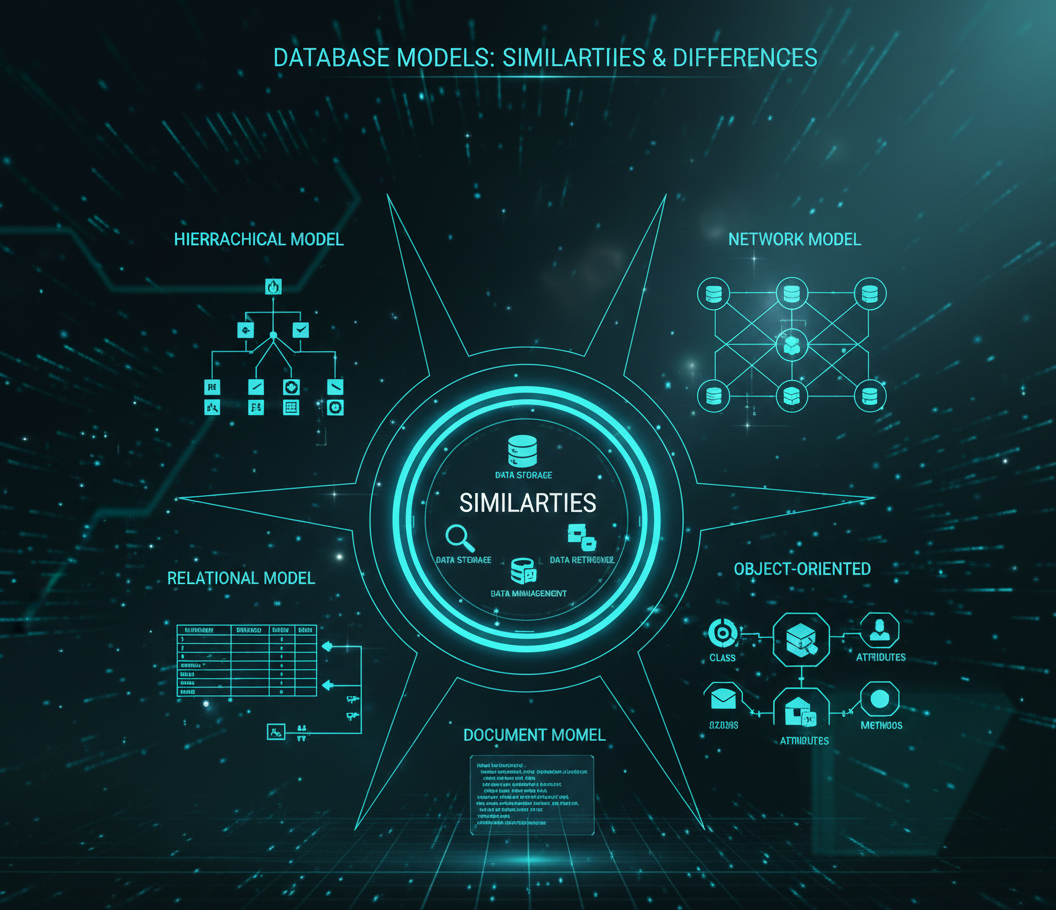
Hierarchical Model
In a Hierarchical database, model data is organized in a tree-like structure. Data is Stored Hierarchically (top down or bottom up) format. Data is represented using a parent-child relationship. In Hierarchical DBMS parent may have many children, but children have only one parent.
Network Model
The network database model allows each child to have multiple parents. It helps you to address the need to model more complex relationships like as the orders/parts many-to-many relationship. In this model, entities are organized in a graph which can be accessed through several paths.
Relational model
Relational DBMS is the most widely used DBMS model because it is one of the easiest. This model is based on normalizing data in the rows and columns of the tables. Relational model stored in fixed structures and manipulated using SQL.
Object-Oriented Model
In Object-oriented Model data stored in the form of objects. The structure which is called classes which display data within it. It defines a database as a collection of objects which stores both data members values and operations.